News
North Carolina State Ports Authority Releases New Strategic Plan
March 30, 2026
Wilmington, N.C. – The North Carolina State Ports Authority released its new 2031 Strategic Plan, which will guide corporate strategy over the next five years.
This Strategic Plan will help position the North Carolina Ports team to achieve its winning aspiration of being the Southeast’s most trusted, preferred, efficient, customer centric gateway by providing seamless, diversified total cost-advantage solutions for customers, bolstering North Carolina’s economy.
“This strategic plan provides a clear, disciplined path forward for North Carolina Ports, aligning our investments and operations with the needs of our customers and the state’s evolving economy,” said Brian E. Clark, Executive Director, North Carolina Ports.
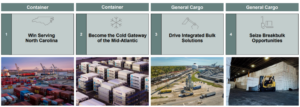
Four strategic focus areas have been identified to drive this plan: 1) Win Serving North Carolina 2) Become the Cold Gateway of the Mid-Atlantic 3) Drive Integrated Bulk Solutions 4) Seize Breakbulk Opportunities.
Win Serving North Carolina
Over the next five years, the NC Ports team will focus on becoming the preferred port for North Carolina businesses by delivering simple, reliable, end-to-end solutions anchored in high-demand North Carolina metros. These efforts will be scaled statewide through tailored customer and industry-specific value propositions.
Become the Cold Gateway of the Mid-Atlantic
Through this 2031 Strategic Plan, the Port of Wilmington will continue to grow cold and frozen refrigerated container volume and value to capture the Mid-Atlantic share of this attractive and growing specialized market. Freshness will be our signature capability.
“By 2031, this plan positions NC Ports’ container business to drive meaningful growth by targeting underserved markets, key industries, and strategic regions across North Carolina,” Clark said. “Through a strong focus on customer-centric, end-to-end solutions, and expanded cold chain capacity, the Port of Wilmington will play an important role in delivering greater value to customers and supporting the state’s economic growth.”
Drive Integrated Bulk Solutions
The teams in both Wilmington and Morehead City will also establish integrated solution partnerships for new investments that drive growth in targeted sectors important to the North Carolina economy. This strategy will attract third-party investment to modernize bulk facilities at both terminals.
Seize Breakbulk opportunities
This plan positions North Carolina Ports to remain agile in responding to key opportunities within breakbulk and project cargo, with a deliberate focus on where to compete and how to execute against these opportunities.
“By 2031, we will increase bulk volume by 1.1 million tons by establishing ourselves as the default gateway for bulk materials serving North Carolina,” said Clark. “We will also increase breakbulk volume by 0.5 million tons with planned, deliberate customer programs, adequate space, and trained teams that deliver materials needed to support growth across the state.”
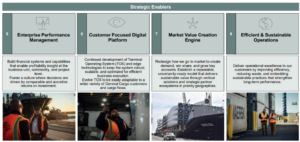
To be successful, these four strategic focus areas will require support in the form of four strategic enablers: 1) Enterprise Performance Management 2) Customer Focused Digital Platform 3) Market Value Creation Engine 4) Efficient & Sustainable Operations. This includes building financial systems and capabilities, continuing development of the Terminal Operating System (TOS), redesigning how we go to market, and delivering operational excellence to our customers by improving efficiency, reducing waste, and embedding sustainable practices that strengthen long-term performance.
Implementation and execution are already underway, with teams across Wilmington, Morehead City, and the Charlotte Inland Port aligned around key priorities, performance metrics, and timelines to ensure successful delivery. North Carolina Ports will continue to communicate progress as the organization advances its strategic focus areas and drives long-term value for customers and the state.
About North Carolina Ports
With deepwater port locations in Wilmington and Morehead City, plus an inland port in Charlotte and intermodal rail access through CSX’s Carolina Connector (CCX) in Rocky Mount, North Carolina Ports links consumers, businesses and industries to world markets. Our ports also serve as magnets to attract new business and industry to the State of North Carolina. Port activities contribute statewide to more than 88,200 jobs and $660 million each year in state and local tax revenues.